Is your paving
contractor legit?
Score them 0-100 across 8 dimensions before you sign.
Most bad paving outcomes don't come from bad work — they come from contractors who shouldn't have been hired in the first place. Find out before you sign.
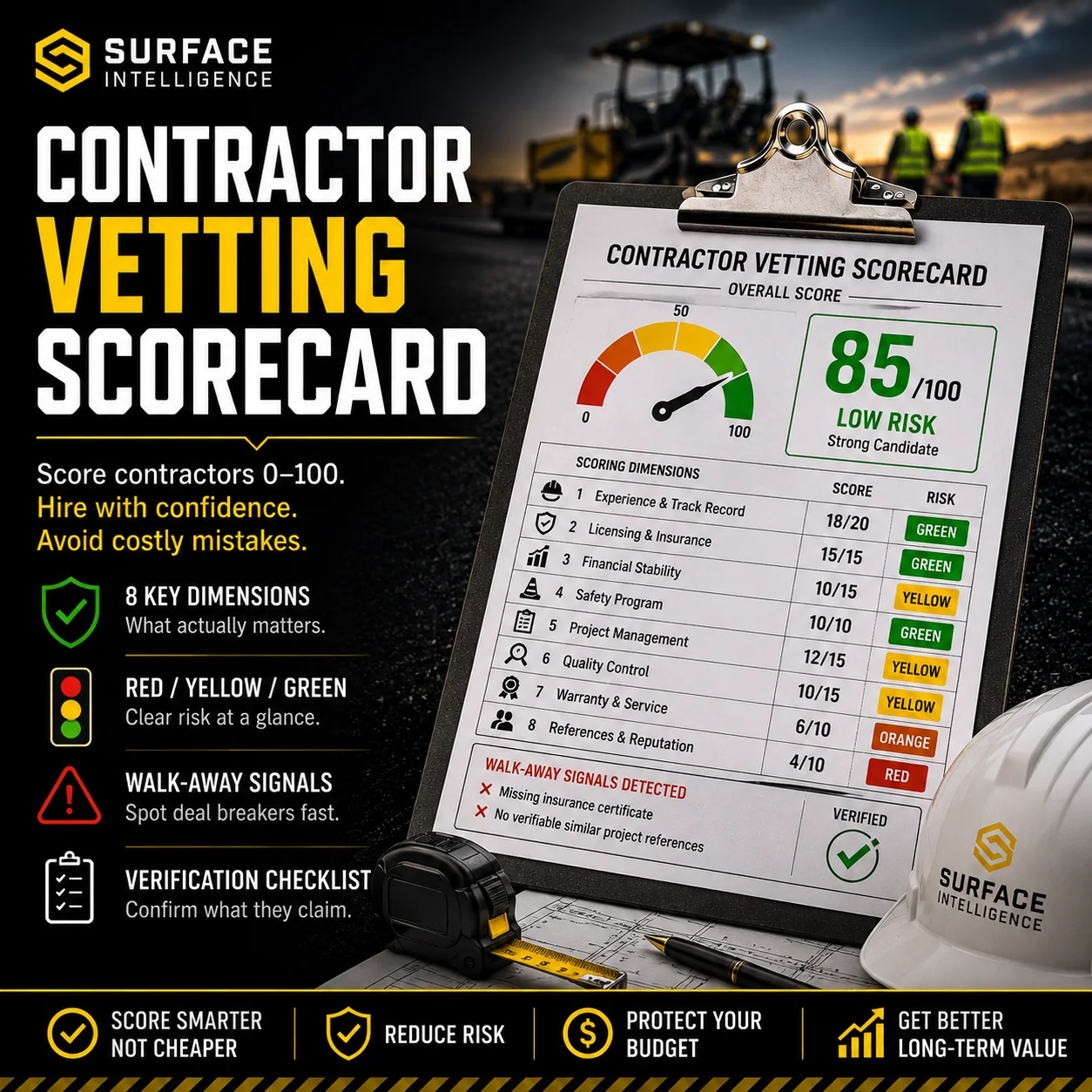
Active + correct class
GL + WC + adequate limits
Capacity vs project value
Recent + similar + verified
Structural + written
Itemized + specified
Site walk + responsive
Years + similar work
Using the Contractor Vetting Scorecard
This scorecard is designed for the moment before a paving contract is signed. It helps property managers compare license status, insurance documentation, warranty clarity, proposal detail, communication quality, references, subcontractor disclosure, and red flag contract language. A contractor can be qualified and still be a poor fit for a specific property if the bid is vague or the project manager cannot explain base repair, ADA scope, traffic control, or phasing. Use the scorecard to create a written record of why a contractor was approved, rejected, or asked for clarification.
Keep the completed scorecard with the contractor's license number, insurance certificate, and reference notes. If a claim or dispute ever comes up, a dated record of what you verified before signing is worth far more than memory.
Contractor review checklist
A paving contractor should be evaluated on more than price and availability. Confirm license status, insurance, workers compensation, local references, similar project experience, warranty language, subcontractor use, and whether the estimator can explain the scope in plain language. If the proposal is vague before signing, it rarely becomes clearer after mobilization.
Ask direct questions about base repair, asphalt thickness, compaction, tack coat, edge milling, ADA responsibility, striping, traffic control, phasing, and cleanup. Good contractors can explain what is included, what is excluded, and what conditions could trigger a change order. Weak proposals often hide those items behind lump sums.
Keep the completed scorecard with the project file. It gives managers a clear reason for rejecting risky bids and protects the decision when a board member asks why the cheapest contractor was not selected.
Use this page together with field photos, contractor notes, budget history, and owner or board priorities. The more complete the project file is before bids are approved, the easier it is to defend the final scope, schedule, and cost.