Create a Parking Lot Maintenance Plan
Turn pavement condition, material, climate, and last-service dates into a practical maintenance calendar your board or owner can understand.
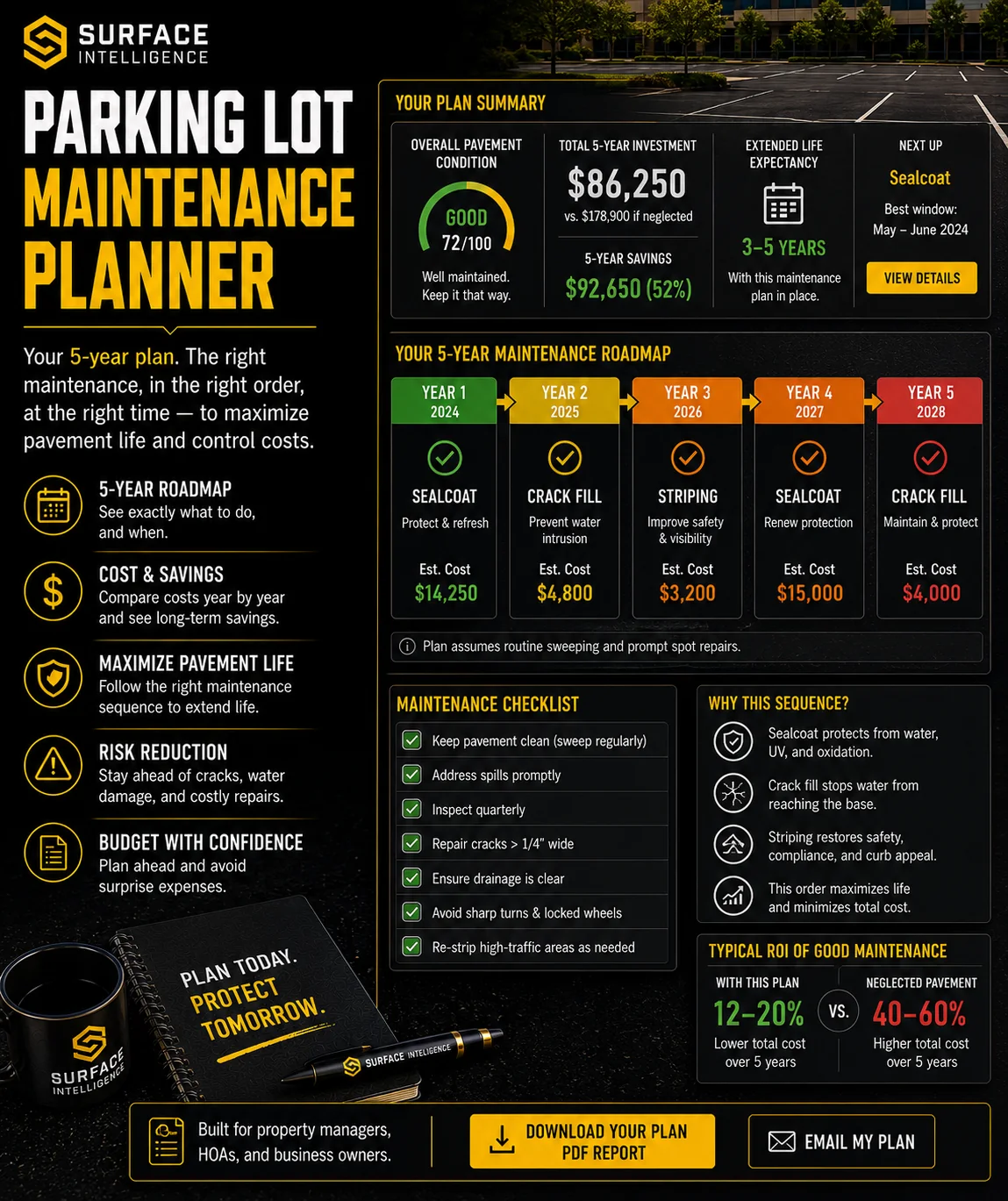
Your 3-year plan will appear here.
Using the Maintenance Planner
The annual maintenance planner helps property teams decide what should happen this year instead of waiting for pavement to fail visibly. Crack sealing, sealcoating, patching, drainage correction, striping, and ADA touchups each belong at different points in the pavement lifecycle. A lot with active alligator cracking needs a different plan than a lot that is mostly oxidized but structurally sound. Use the planner before budget season, before soliciting bids, and after winter storms so routine maintenance is separated from capital repair work.
Keep the plan with dated photos and the last-service dates so it can be updated each budget cycle. A maintenance plan only protects pavement if it is revisited and funded, not filed and forgotten.
From condition to a plan you can budget
You enter material, property type, climate, lot age, current condition, and area. The planner sequences the work the way an experienced crew would walk it: water control first, then surface protection, then striping and ADA markings, then the reserve targets that keep a bad year from becoming a capital emergency. Every line carries a planning cost so the schedule reads like a budget, not a wish list.
Plan across three horizons
- This year. Crack sealing, isolated patching, sealcoat evaluation, and striping. These are the low-cost items that protect the surface you already paid for.
- Three years. Drainage and edge repair, trip-hazard work on concrete, and the point where you decide whether an overlay is coming. This is the window most properties underfund.
- Long term. Overlay or panel-replacement reserve targets so the eventual big number is funded on purpose rather than deferred until failure.
Factors that move the schedule
- Climate. Freeze-thaw and hot-inland lots oxidize and crack on different clocks, which changes sealcoat timing.
- Condition and age. A fair lot with active cracking needs water control now. A good lot mostly needs to hold its cycle.
- Material. Asphalt lives on sealcoat and crack fill. Concrete lives on joint sealant and panel care.
- Traffic and use. Trucks, trash routes, and turning movements pull maintenance forward.
Example
A 42,000 square foot HOA asphalt lot in fair condition gets crack fill and patching in spring, a sealcoat evaluation once oxidation is confirmed, a restripe in summer, a drainage allowance in year two, and an overlay decision point in year three. Presented that way, a board can see that a few thousand dollars of routine work now is what defers a six-figure replacement later.
Limitations
This is a planning framework, not a specification or a bid. Timing and cost depend on real condition, climate, and site access. Confirm the scope with a site walk before you put dollars in a budget or send it out for pricing.
Maintenance planning questions
How often should a commercial asphalt lot be sealcoated?
Most commercial lots fall in a rough three to five year sealcoat window, but the right answer is condition-driven, not calendar-driven. Sealcoat protects a sound surface. If the base is failing or cracking is widespread, sealcoat is the wrong spend, and the planner flags that.
What is the difference between a one-year and a three-year pavement plan?
A one-year plan handles the routine work due this budget cycle. A three-year plan sequences that routine work alongside the larger decisions, drainage correction and the overlay-or-replace call, so funding is staged instead of hitting all at once.
Why put maintenance in writing for a board or owner?
A written, dated plan separates routine maintenance from capital repair, supports reserve funding, and gives a board a defensible reason to approve small spending now to avoid a large request later. It also becomes part of the property file if conditions or liability are ever questioned.
Keep going
Pavement Condition Assessment Tool
Rate the lot first so the plan reflects real condition.
Sealcoating Calculator
Estimate sealcoat cost and check whether the timing is right.
HOA Pavement Reserve Calculator
Turn the long-term line items into a reserve target.
Parking Lot Closure Notice
Generate the tenant notice before scheduled work begins.