Should You Repair or Replace Your Asphalt?
Compare the quote in front of you against a replacement option. Get the break-even year, 10-year cost picture, and a plain-English recommendation for owners or boards.
Current pavement
Quoted options
Using the Repair vs. Replace Calculator
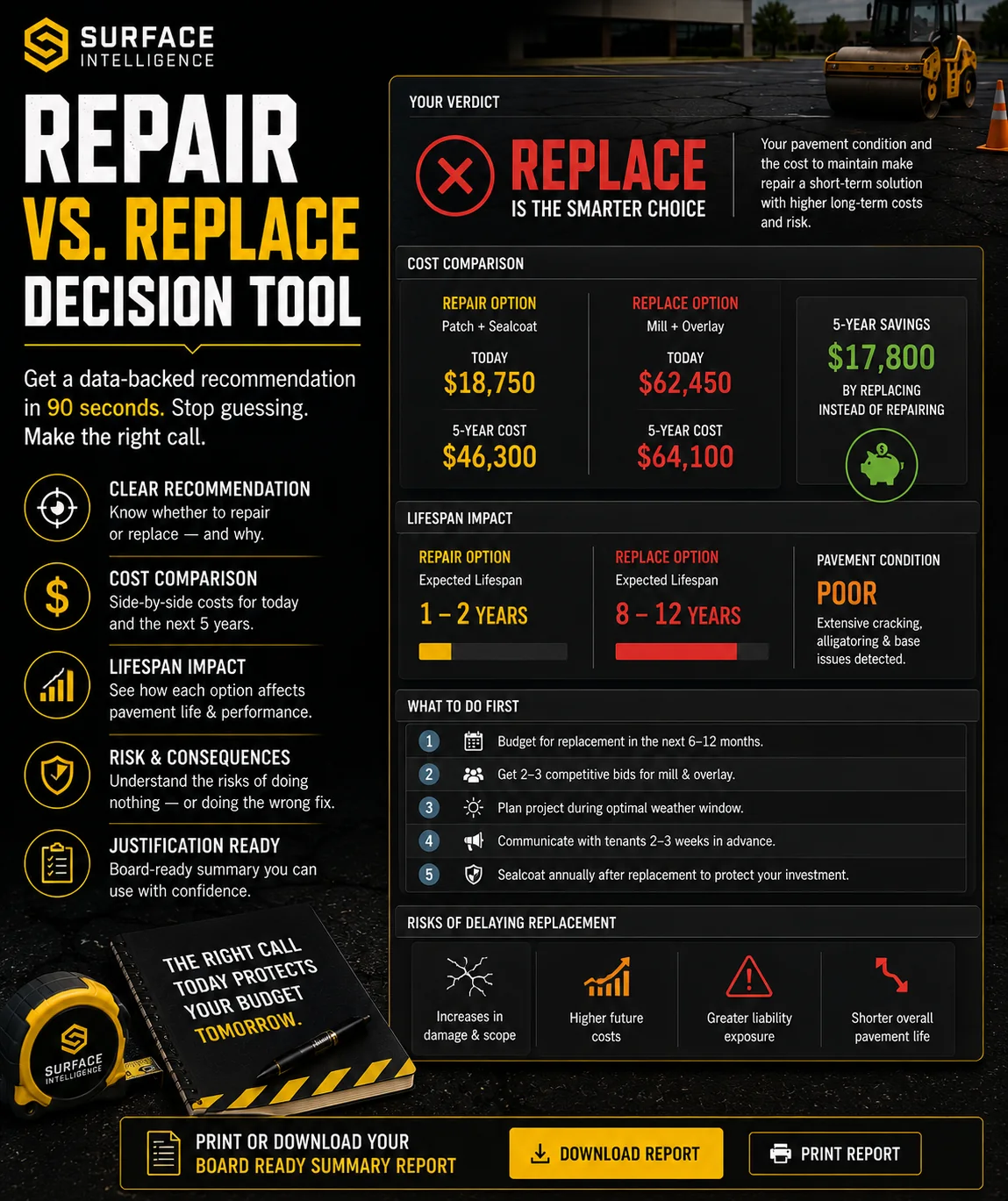
Repair decisions become expensive when short-term savings hide repeated mobilization, tenant disruption, and another capital request in a few years. This calculator helps compare targeted repairs against overlay or reconstruction by looking at condition, expected useful life, estimated cost, and risk. A repair can be the right answer when distress is isolated and the base is stable. Replacement or structural rehabilitation becomes more defensible when cracking is widespread, drainage is poor, or surface repairs no longer buy meaningful time.
Save the comparison with the two quotes and dated photos of the distress. When you take a repair-or-replace decision to an owner or board, showing the break-even math next to the field condition is what makes the answer defensible.
What this calculator compares
You enter the pavement age and condition, your remaining hold period, and the two quotes in front of you: a repair scope and a replacement scope, each with an expected useful life. The tool projects the repair path across your hold period, including the likely repeat repair cycles that a short-life patch forces, and compares it against replacement plus a light lifecycle maintenance allowance. It returns an approximate break-even year and a plain-English read on which path is the stronger capital decision.
Factors that change the answer
- How isolated the distress is. A few failed areas over a stable base favors repair. Widespread alligator cracking and pumping favors replacement.
- Base and subgrade condition. Surface repairs do not fix a failing base, and a soft subgrade shortens the life of any overlay.
- Drainage. Standing water and poor grade pull useful life out of both paths, and often out of a repair faster.
- Hold period. A short ownership window can make a repair defensible even when replacement is technically better.
- ADA exposure. Any work that touches existing grades can trigger accessibility review, which belongs in the replacement budget.
Example
An eighteen-year-old lot with fair-to-poor surface condition gets a 65,000 repair quote with a four-year life and a 220,000 replacement quote with an eighteen-year life on a ten-year hold. Because the repair has to be redone about twice inside that window, the projected repair path narrows against replacement, and the break-even year usually lands inside the hold period. The tool shows both ten-year numbers side by side so the decision can be explained to an owner or board with a number, not a hunch.
Limitations
This is a planning comparison, not a verdict and not a field inspection. It cannot see base failure, drainage, or subgrade moisture. Use the result to frame the conversation, then confirm the real path with a site walk and, where the base is in question, a core or a closer look at the failed areas.
Repair or replace: frequently asked questions
Does asphalt age alone mean I should replace it?
No. Age is a signal, not a trigger. A well-built lot that was sealed and crack-filled on schedule can outlast a neglected lot that is ten years younger. Condition, base stability, and lifecycle cost drive the decision more than the number of years.
When is a repair the wrong call?
When cracking is widespread, when water is sitting on the surface, or when you have already patched the same areas more than once. At that point repairs usually buy a short amount of time at a high repeat cost, and replacement or structural rehabilitation is easier to defend.
What is an overlay, and where does it fit?
An overlay places new asphalt over a sound existing base. It sits between a repair and a full replacement on both cost and life. If the base is stable and grades allow it, an overlay can be the most cost-effective path, which is why a condition assessment before bidding matters.
Keep going
Pavement Condition Assessment Tool
Rate the lot first so your repair and replacement inputs reflect real condition.
Parking Lot Paving Cost Calculator
Pressure-test the replacement number with a commercial paving cost range.
Parking Lot Maintenance Planner
If you repair, build the plan that protects the surface you keep.
Pavement ROI Calculator
Translate the decision into NOI and property-value impact for owners.