Parking Lot Paving Cost Calculator
How much will your project actually cost? Get a realistic low/mid/high range based on your scope, region, and site conditions.
Your Property
Tell us about the property type, size, and location so we can apply the right regional pricing.
Scope of Work
Select the project type and any site conditions that affect scope and cost.
Get Your Estimate
Enter your contact info to generate your estimate. Ryan may follow up with questions or context.
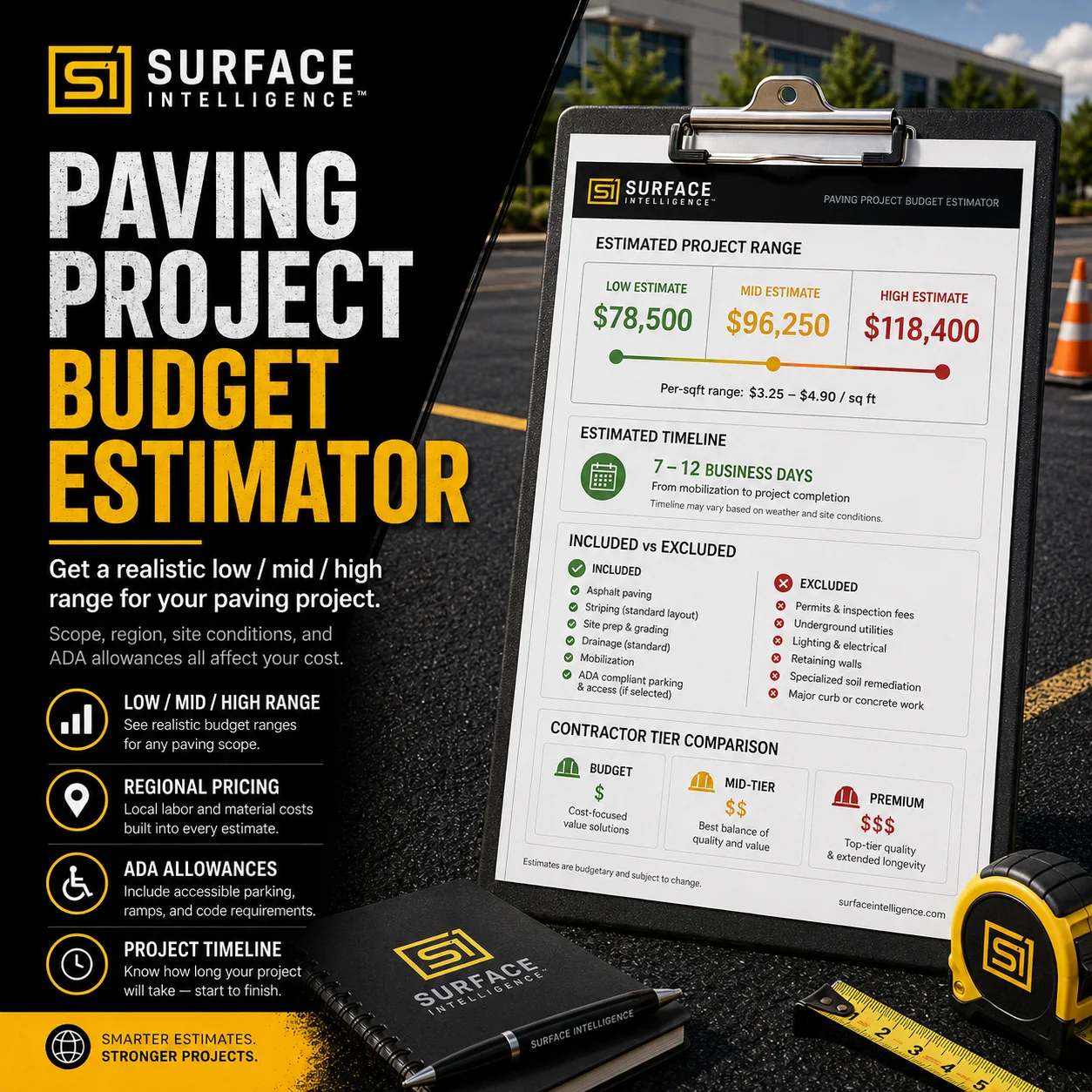
Estimated Project Range
Based on your inputs.
Estimated Timeline
What's Typically Included vs. Excluded
| Typically included | Typically excluded (ask explicitly) |
|---|
Understanding Contractor Tiers
Get a Forticon quote for this scope
Ryan will review your inputs and provide a real bid for your property — not a range.
Using the Paving Budget Estimator
Budget ranges are most useful before a formal bid package is written. This estimator helps property managers create a planning number for overlay, repaving, patching, crack sealing, sealcoating, striping, and ADA-related allowances. The number should be treated as a capital planning range, not a contractor quote. Regional pricing, access constraints, phasing, base repair, drainage work, utility covers, and traffic control can move the final cost. Use the estimate to decide whether a project belongs in this year budget, reserve planning, or a phased multi-year plan.
Save the range with the property's square footage, the assumed scope, and the date. A planning number stays useful only if everyone remembers it is a range built on assumptions, not a bid.
How the paving cost estimate is built
You enter the property type, square footage, region, scope, subgrade condition, and ADA scope. The tool applies a per-square-foot rate range for that scope, adjusts it for regional labor and material differences, adds an allowance where the base is questionable, and adds a separate line for ADA work. The output is a low, mid, and high project range plus a per-square-foot figure, so you can see both the unit cost and the total.
What the estimate can include
- Asphalt replacement. Remove and replace the surface, and sometimes the base, when the pavement is past rehabilitation.
- Mill and overlay. Grind the top layer at transitions and pave a fresh surface over a sound base.
- Asphalt overlay. A new lift over existing pavement where grades and base allow it.
- Full-depth repair. Dig out and rebuild failed areas down through the base.
- ADA correction allowances. A separate budget line, since accessible route and slope work is priced on its own.
- Mobilization and phasing. Getting equipment to the site and keeping part of the lot open during work.
Factors that move the number
- Base repair and subgrade uncertainty. Soft spots and standing water are the most common reason a number climbs after the surface comes off.
- Cost per square foot compared with total project cost. Small lots carry fixed mobilization, so their per-foot number runs higher than a large lot.
- Regional cost variation. Labor, plant location, and material markets differ across California and beyond.
- Project access and trucking. Tight sites, long haul distances, and limited staging raise cost.
- Drainage and grade correction. Fixing ponding or re-establishing fall adds scope beyond a flat resurface.
- Striping, wheel stops, signs, and concrete additions. These are commonly separate line items, not part of the asphalt unit price.
Limitations
This is a capital planning range built on 2026 Bay Area and Northern California rates, not a bid. Prevailing wage, permits, disposal, traffic control, and unseen base failure can all move the final cost. Use it to decide whether a project belongs in this year budget, reserve planning, or a phased plan, then get a real bid for the actual scope.
Paving cost questions
How much does it cost to pave a commercial parking lot?
It depends on scope. An overlay costs less per square foot than a full replacement, and a small lot costs more per foot than a large one because of fixed mobilization. This tool gives a low-to-mid-to-high range for your scope, region, and condition, but only a site-specific bid reflects your actual base, drainage, and ADA scope.
What is the difference between an overlay and a full repave?
An overlay places new asphalt over a sound existing base and costs less. A full repave removes the old surface, and sometimes the base, and rebuilds it. When the base is failing or drainage is bad, an overlay does not last, so the cheaper option is not always the cheaper outcome.
Why is ADA work priced separately?
Accessible route, slope, and access-aisle work is measured and priced on its own because it can require concrete, grade changes, and signage that the asphalt unit price does not cover. Budgeting it as a separate line keeps the estimate honest.