
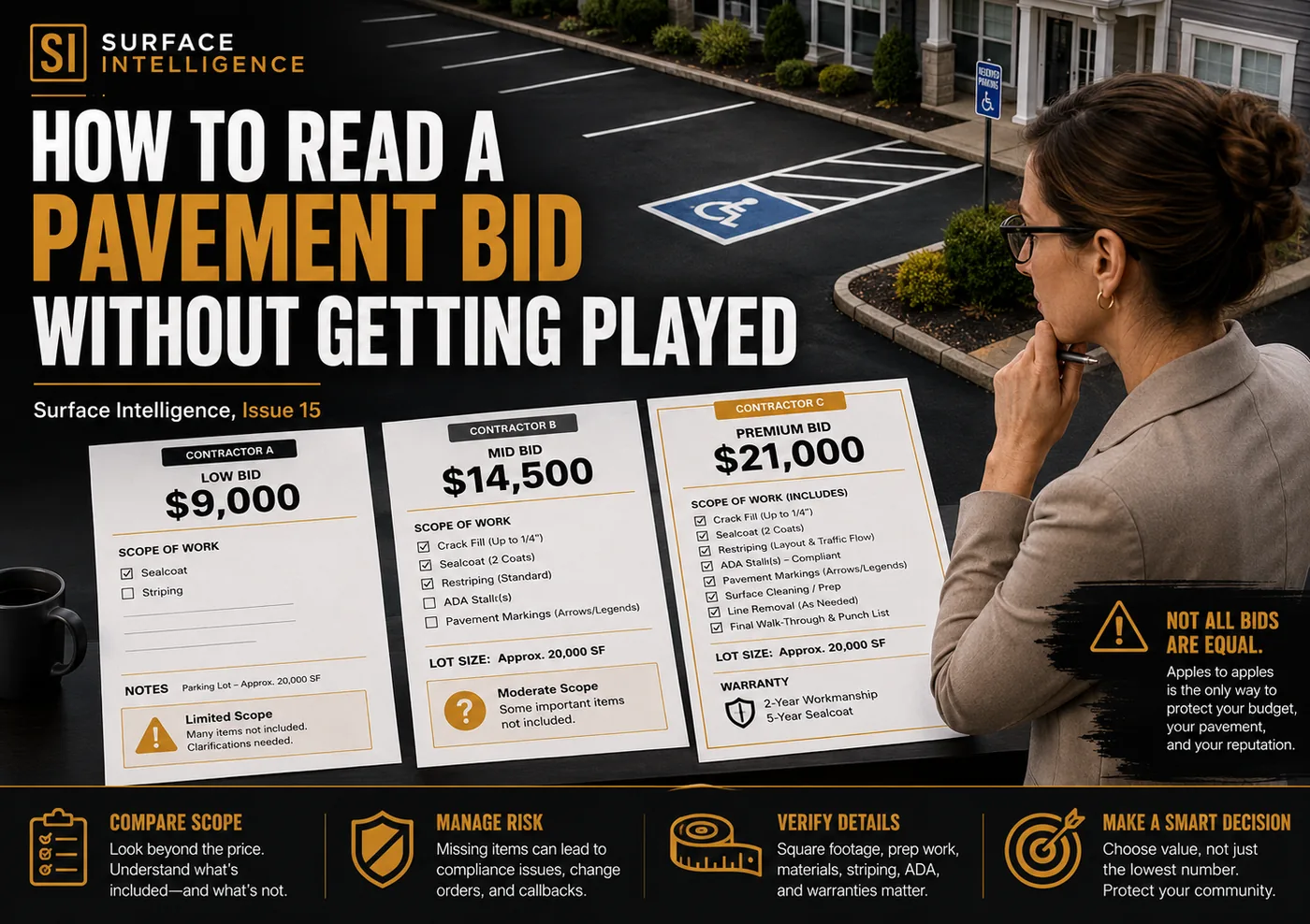
A property manager forwarded me three bids last month. Same parking lot. Same scope, supposedly.
If the property has not documented its maintenance priorities and failure conditions, start with the Parking Lot Maintenance Guide for Property Managers. Bid comparison only works after the property understands what problem it is trying to solve.
Nine thousand. Fourteen five. Twenty-one thousand.
She asked which one was the best deal.
The honest answer is that I couldn't tell her, and neither could she. The three contractors weren't bidding the same job. They just made it look that way.
Three Bids, One Lot, Three Different Jobs
A pavement bid looks like a price. It is actually a scope wearing a price tag. Hand the same lot to three contractors and you get three different ways of measuring it, three different definitions of the work, and three numbers that have no business sitting in the same column. The spread is not telling you who is cheap. It is telling you they bid different jobs.
Here is where the scope hides.
The Square Footage Sleight of Hand
It starts with measurement. One contractor measured the whole lot at 35,000 square feet. Another quoted 28,000, because that was the area he actually planned to touch. A third just rounded. That gap alone moved the price by thousands before anyone said a word about quality. If two bids do not agree on the size of your lot, nothing else they say is comparable. Ask each one how they measured and what number they used. The answers will not match.
Thickness and Tonnage Tricks
“Two inches of asphalt” can mean compacted thickness or loose placement thickness. Those are not the same result. A proposal should state compacted thickness, asphalt mix, preparation, and where the section changes.
Tonnage also needs context. Ask how tons were calculated, what density assumption was used, and whether overruns become change orders. A technical-looking number can still hide an undefined scope.
"Fill the Cracks" Means Nothing
Crack repair is the emptiest line in any bid. "Fill the cracks" does not say which cracks, everything over a quarter inch or only the wide ones somebody trips over. It does not say hot-applied rubberized material, which bonds and flexes, or cold pour from a jug, which is cheaper and gone in a season. It does not say whether they rout the crack first or just smear over it. Same two words on all three bids. Three completely different repairs.
And crack sealing is not busywork. The Federal Highway Administration lists crack sealing as an eligible pavement preventive maintenance activity when used as a cost-effective way to extend pavement life, because water getting into a crack is what destroys the base underneath.
The Sealcoat Shell Game
Sealcoat is the same story. One coat or two. Sprayed or squeegeed. Asphalt emulsion, additives, sand load, drying time, and dilution rate. A contractor can water the material down, cover the same lot for less, and hand you a number that looks great until it wears thin inside a year. The bid will not mention any of this. You have to make it.
Use the Sealcoat Timing Calculator before you assume sealcoat belongs in the scope at all. If the surface is too far gone, sealcoat can make a weak bid look responsible while hiding the repair conversation that should have happened first.
The Striping Line That Becomes a Lawsuit
Then striping, where the real liability lives. One bid restripes the layout that is already there. Another brings the accessible stalls up to current standards. This is not optional and it is not cosmetic. The Department of Justice is explicit that when a business restripes a parking lot, it has to provide accessible spaces that meet the 2010 ADA Standards.
The rules are specific. Accessible stalls and their access aisles cannot slope more than 1:48 in any direction, which is roughly 2.08 percent and nearly flat. The access aisle has to be at least 60 inches wide, the car stall at least 96 inches, and one of every six accessible spaces has to be van accessible.
The bid that quietly repaints your old layout is not the cheaper bid. It is the incomplete one, and the day that striper lays down noncompliant stalls, the exposure becomes yours.
If ADA is part of the project, run the ADA Risk Scorecard before the scope goes out. It gives you a cleaner list of issues to document before contractors start guessing.
Warranty Language That Sounds Better Than It Is
A warranty is only as useful as its exclusions. Read what happens to cracking, drainage-related failure, settlement, utility work, oil damage, heavy vehicles, and areas with known base problems. Confirm who decides whether a failure is workmanship or an excluded condition.
Also confirm the remedy. Repair, credit, material replacement, and “contractor discretion” are very different promises.
What the Spread Is Really Telling You
Now watch what happens when you normalize those three bids to the same scope. The twenty-one thousand dollar bid turns out to be the only complete one. The nine thousand dollar bid was real, for the work it described, which was a fraction of the job. Approve it and it grows by change order until it quietly passes the bid you rejected for being too high. You did not save money. You paid in installments and lost the warranty along the way.
This is the math that should drive every pavement decision you make. Pavement preservation research has found that every dollar spent on preventive maintenance at the right time can save several dollars in later rehabilitation, with some studies showing savings in the $6 to $10 range. The cheap incomplete bid does not just underdeliver today. It pushes your lot toward the expensive end of that curve.
Make Them Bid the Same Job
The fix is simpler than the problem. Stop letting each contractor define the work. Hand all of them the same scope before they quote, down to the crack fill spec, the number of coats, the square footage method, the ADA requirements, and the warranty terms. When everyone bids the same job, the only things left to compare are price and reputation. Which is what you wanted to compare in the first place.
Some contractors do not mind vague scope. The good ones will bid a clean spec. The bad ones need the gray area. That is exactly why you should have it.
Questions to Ask Before Signing
- What exact area and square footage are included?
- What compacted thickness and asphalt mix are specified?
- How were tonnage and quantities calculated?
- What base repair allowance is included?
- How are drainage, transitions, striping, and ADA handled?
- What is excluded from the warranty?
- What useful life does the contractor expect?
Repair and material assumptions should align with Patch, Overlay, or Replace? and Asphalt vs Concrete Parking Lots.
Turn this into a cleaner bid process.
Use these before you send the job out, compare contractor numbers, or present the project to ownership.
Get the Pavement Scope Template.
I built the one-page scope template I hand to property managers so all contractors bid the same job: square footage, crack repair, sealcoat spec, striping, ADA assumptions, warranty language, and exclusions.
Sources
- U.S. Department of Justice, ADA Compliance Brief: Restriping Parking Spaces.
- U.S. Department of Justice, Accessible Parking Spaces.
- Federal Highway Administration, Preventive Maintenance Eligibility.
- National Park Service, Pavement Preservation: A Proactive Approach.