
Asphalt and concrete are not interchangeable. They both handle traffic. They both create access. They both fail when used in the wrong place.
But they do not fail the same way, cost the same way, drain the same way, repair the same way, or perform the same under heavy loads.
That is where property managers get burned. They ask, “Which is cheaper?” The better question is: Where should each material be used on this property?
This decision should sit inside a broader parking lot maintenance plan, because first cost means little without drainage, loading, repair timing, and expected service life.
For many parking lots, asphalt makes sense across the main parking field and drive aisles. Concrete may make more sense in high-load, high-turning, drainage-sensitive, or ADA-sensitive areas.
The mistake is not choosing asphalt or concrete. The mistake is choosing one material everywhere without understanding what each area of the property is asking it to do.
| Category | Asphalt | Concrete |
|---|---|---|
| Best use | Large parking fields, drive aisles, and private roads | ADA stalls, dumpster pads, truck aprons, sidewalks, and high-load areas |
| Typical advantage | Lower initial cost, faster installation, and easier phased repairs | Better load resistance, longer service life in certain conditions, and precise grade control |
| Common failure | Cracking, oxidation, potholes, rutting, and base failure | Cracking, spalling, displacement, settlement, and joint failure |
| Maintenance | Crack sealing, sealcoat, patching, overlays, and replacement | Joint and crack repair, grinding, spall repair, and slab replacement |
| Biggest mistake | Using it where heavy loads or poor drainage will destroy it | Using it everywhere when asphalt would be more cost-effective |
| Property manager concern | Maintenance timing, drainage, and base condition | Higher initial cost, cure time, and disruptive slab repairs |
Asphalt vs Concrete Parking Lot: The Simple Answer
For most commercial parking lots and HOA parking areas, asphalt is commonly used for large parking fields and drive aisles because it is generally faster to install, easier to phase, and usually has a lower upfront cost.
Concrete is commonly used where pavement needs more precise grade control, greater load resistance, or better performance under repeated stress. That includes:
- ADA parking stalls and access aisles
- Sidewalks, curb ramps, and accessible routes
- Dumpster pads and trash enclosure approaches
- Loading areas and truck aprons
- Drainage channels and valley gutters
- Heavy turning areas
Commercial Concrete Flatwork vs Asphalt for Parking Lots
Commercial concrete flatwork and asphalt paving are often discussed as if they are competing options for the same job. In the field, they usually serve different purposes.
Concrete flatwork is usually the better choice where the property needs clean grade control, pedestrian access, slab strength, or repeated load resistance. Asphalt is usually the better choice where the property needs broad pavement coverage, flexible repair options, and a more cost-effective surface for passenger vehicle traffic.
The question is not whether concrete is “better” than asphalt. The question is whether that specific area needs the characteristics of concrete or the flexibility and cost structure of asphalt.
Where Asphalt Usually Makes Sense
- Main parking fields and standard passenger vehicle stalls
- Drive aisles, private roads, and HOA streets
- Large commercial parking lots
- Areas where phased maintenance matters
- Areas likely to need future utility cuts or repairs
Asphalt is often the practical choice for large parking areas because it can cover more area at a lower upfront cost and can usually be repaired, maintained, or overlaid more easily than concrete.
That matters because most parking lots are not built once and forgotten. They need crack sealing, patching, sealcoating decisions, restriping, drainage review, and eventually larger capital work.
Asphalt gives a property flexibility when the lot is large and traffic is mostly passenger vehicles. But asphalt still needs a plan. If the property ignores cracks, drainage, base failure, or heavy loading, the cost advantage can disappear quickly.
Where Concrete Usually Makes Sense
- ADA stalls, access aisles, sidewalks, and curb ramps
- Dumpster pads and trash enclosure approaches
- Loading zones, truck aprons, and repeated turning areas
- Fire-lane turning areas
- Drainage channels and valley gutters
- Locations where precise slope control matters
- Areas with repeated oil or grease exposure
Concrete usually makes sense where pavement has to carry more stress, hold grade more precisely, or perform in a smaller critical area.
A concrete ADA stall may cost more upfront, but it can make slope control easier than fine-tuning a small accessible area in asphalt. A concrete dumpster pad may cost more than asphalt, but it is usually better suited for repeated trash truck loading and container impact.
The mistake is looking only at square-foot price. The better question is: What happens in this area every day?
Asphalt vs Concrete Cost: Why the Cheapest Material Is Not Always the Cheapest Outcome
Asphalt usually has a lower initial installation cost than concrete. Concrete usually has a higher upfront cost, but it may perform better in specific high-stress areas.
Comparing the materials only by square-foot price misses the bigger cost question: Will this material survive the use case?
A low-cost asphalt repair in a dumpster area may fail quickly if trash trucks turn on it every week. Concrete across an entire large parking field may be unnecessary when traffic is mostly passenger vehicles and the budget would be better spent on a planned asphalt maintenance cycle.
Cost should be evaluated by area, use, traffic, drainage, base condition, and expected performance—not just material name.
Asphalt vs Concrete Over 30 Years
A 30-year comparison should include original construction, base preparation, drainage, maintenance cycles, repair disruption, and replacement risk—not just installation price.
| Planning Period | Asphalt | Concrete |
|---|---|---|
| Initial construction | Usually lower cost and faster reopening across large areas | Usually higher cost and longer cure requirements |
| Early life | Inspect drainage and seal isolated cracks | Inspect joints, settlement, cracking, and transitions |
| Midlife | Crack sealing, patches, possible sealcoat, and overlay planning | Joint work, grinding, spall repair, and slab replacement |
| Later life | Overlay, mill-and-fill, or reconstruction depending on base | Selective slab replacement or broader reconstruction |
For an HOA with broad passenger-vehicle parking, asphalt may preserve more reserve flexibility. For an industrial property with repeated truck turns, concrete may reduce recurring high-stress repairs. The lowest lifecycle cost often comes from using both materials strategically.
Maintenance Differences Property Managers Should Understand
Asphalt Maintenance
- Crack sealing
- Sealcoating
- Patching and dig-outs
- Overlays
- Mill and fill
- Full-depth replacement
Concrete Maintenance
- Joint maintenance
- Crack and spall repair
- Grinding trip hazards
- Slab replacement
- Curb and ramp replacement
Asphalt maintenance is usually more frequent, but it can often be phased and performed over larger areas. Concrete maintenance may be less frequent in some applications, but repairs can be more disruptive and expensive per location when slabs need replacement.
Neither material is maintenance-free. The question is whether the property has a realistic maintenance plan for the material being installed.
How Asphalt and Concrete Fail Differently
Common Asphalt Failures
- Oxidation and raveling
- Cracking and water infiltration
- Alligator cracking
- Potholes and rutting
- Base and edge failure
Common Concrete Failures
- Cracking and spalling
- Joint failure
- Settlement and slab displacement
- Scaling and broken corners
- Trip hazards
Asphalt failure often starts with water and movement. Concrete failure often becomes visible through cracking, displacement, joint problems, or surface breakdown.
The repair strategy changes with the material. Failed asphalt is not repaired the same way as displaced concrete, and the prevention strategy is different too. Material choice belongs in the long-term maintenance plan, not only the original construction decision.
ADA Parking Areas: Why Material Choice Matters
ADA parking areas are one of the most important places to think carefully about asphalt versus concrete. Accessible stalls and access aisles need proper slope, stable surface conditions, drainage, and a usable route to the entrance.
Asphalt can work for ADA areas when it is properly graded and installed. Concrete may provide better control where a property needs precise slope, clean transitions, and longer-term surface stability in a small defined area.
Before paving or restriping accessible stalls, review the ADA parking requirements and document slope, drainage, surface condition, signage, and path of travel.
Drainage Should Influence the Material Decision
Drainage problems can damage both asphalt and concrete, but they show up differently. Standing water on asphalt can accelerate cracking, raveling, potholes, and base failure. Poor drainage around concrete can contribute to settlement, undermining, joint movement, and trip hazards.
Before choosing a material, ask:
- Where does water go after rain?
- Does the area hold standing water?
- Is water flowing through ADA stalls or pedestrian routes?
- Are drains set at the correct elevation?
- Has the area failed before?
- Will the proposed work correct the drainage issue or cover it?
A material change does not automatically solve a drainage problem. Assess the pavement condition and drainage clues before deciding what belongs above it.
Heavy Loads, Dumpsters, and Truck Traffic
Passenger vehicle parking is one thing. Trash trucks, delivery trucks, forklifts, fire apparatus, and loading dock traffic are another.
Heavy loads and tight turning movements can damage asphalt faster than expected, especially near dumpster enclosures, loading docks, delivery routes, industrial yards, fire lanes, driveway entrances, and truck aprons.
Concrete may be the better long-term choice in these areas—not because concrete is always better, but because the use case is more severe. If a truck turns in the same spot every week, the material decision should reflect that.
How Material Choice Affects Contractor Bids
Asphalt and concrete bids are difficult to compare when contractors are not pricing the same assumptions. One may propose asphalt replacement while another proposes concrete. One may include base repair, drainage correction, ADA work, and striping while another excludes them.
Before comparing prices, confirm:
- What material is proposed, and why?
- What thickness and section design are included?
- Is base preparation or repair included?
- Is drainage correction included?
- Are striping, signage, and ADA work included?
- What areas and conditions are excluded?
- What future maintenance should be expected?
A lower price may simply mean a thinner scope. If the existing failure pattern is still unclear, complete a parking lot pavement assessment and review the property conditions before requesting bids.
Then use the paving bid review guide or Bid Decoder to compare what each contractor actually included.
If the existing pavement is already failing, use Parking Lot Repairs: Patch, Overlay, or Replace? before changing materials by default.
Asphalt or Concrete? Practical Decision Matrix
| Property Condition | Better Starting Point |
|---|---|
| Large passenger vehicle parking field | Asphalt |
| HOA private roads | Asphalt |
| Standard drive aisles | Asphalt |
| ADA stall where slope precision is critical | Concrete may be better |
| Dumpster pad | Concrete |
| Loading dock apron | Concrete |
| Heavy truck turning area | Concrete may be better |
| Area with standing water | Fix drainage first |
| Failed base | Repair the base before either material |
| Sidewalk trip hazard | Concrete repair or replacement |
| Budget-limited broad maintenance | Asphalt maintenance plan |
| Small high-stress repair area | Concrete may be better |
Common Mistakes Property Managers Should Avoid
- Choosing asphalt only because it is cheaper upfront. First cost does not matter if the use destroys the repair.
- Choosing concrete everywhere because it seems more durable. Durability does not automatically justify the cost across a large passenger-vehicle lot.
- Ignoring traffic loading and turning movements. Repeated heavy loads change the material decision.
- Ignoring drainage or failed base. Neither surface can rescue bad support or trapped water.
- Placing ADA stalls without checking slope. Material and grade have to be designed together.
- Using asphalt where concrete is needed for truck loading. The same failure often returns.
- Installing concrete without considering future utility work. Later access can become expensive and disruptive.
- Comparing bids without checking scope. Material names do not prove equivalent work.
- Treating sealcoat as structural repair. Sealcoat does not fix failed base, grade, or load damage.
- Letting a contractor define the material choice without explanation. The recommendation should connect to field conditions and expected use.
The wrong material in the wrong place is not a savings strategy. It is a future repair.
Field Examples
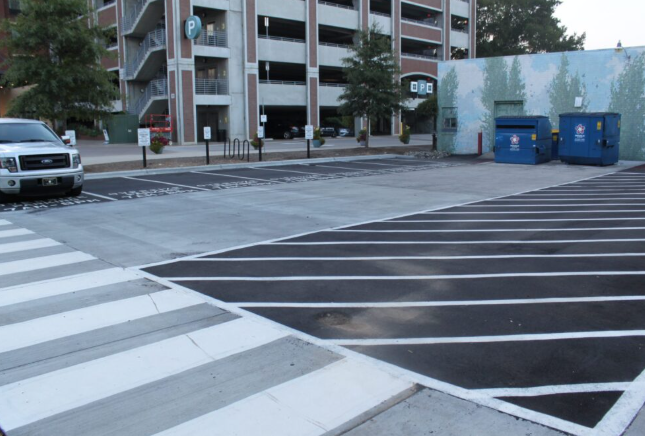
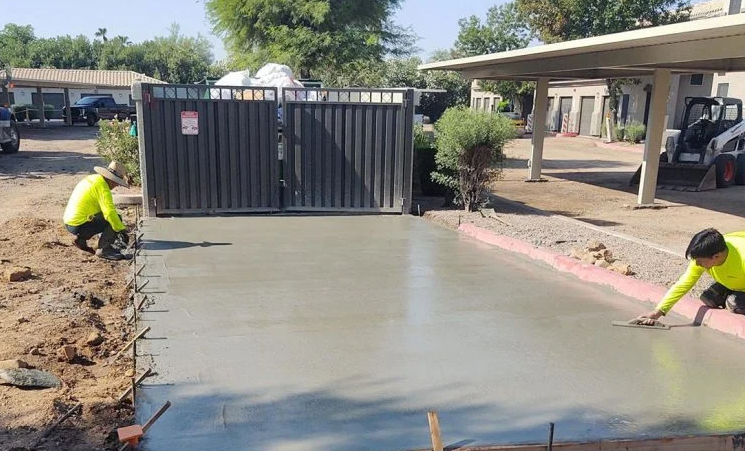
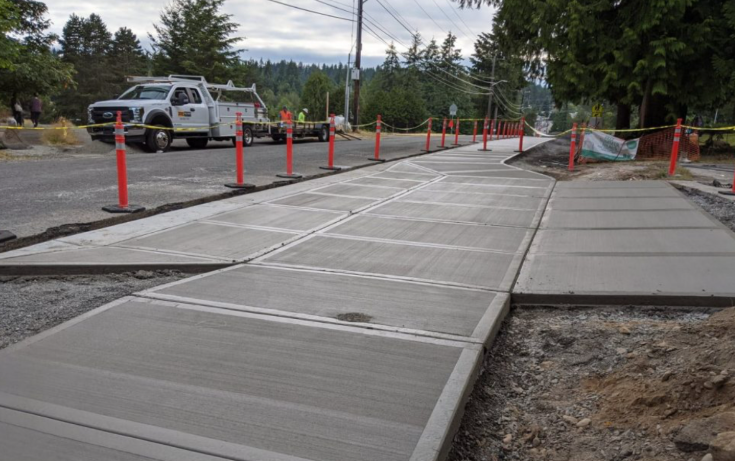
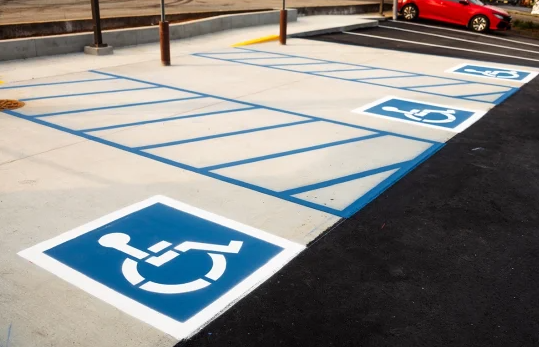
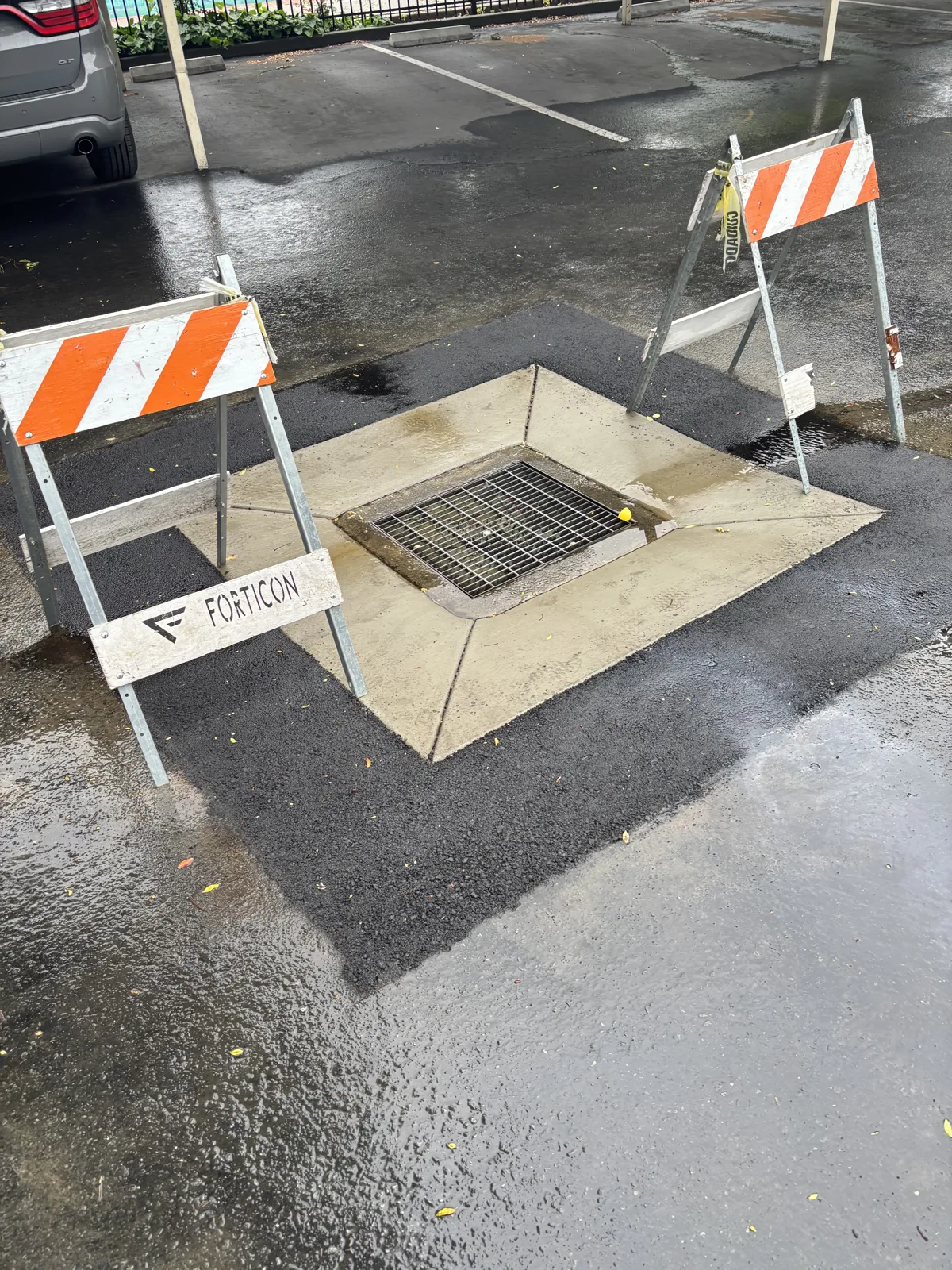
These commercial property examples show why material choice should change with location, loading, drainage, access, and expected use.
Related Surface Intelligence Tools
Frequently Asked Questions
Is asphalt or concrete better for parking lots?
Neither is always better. Asphalt is often better for large parking fields and drive aisles. Concrete is often better for ADA stalls, dumpster pads, sidewalks, truck aprons, and high-load areas.
Is asphalt cheaper than concrete for parking lots?
Asphalt usually has a lower upfront cost than concrete, but cost should be evaluated by location, traffic, drainage, expected maintenance, and failure risk.
When should concrete be used instead of asphalt?
Concrete should be considered in areas with heavy loads, tight turning movements, dumpsters, loading areas, sidewalks, curb ramps, and ADA areas where slope precision matters.
Can asphalt be used for ADA parking stalls?
Yes. Asphalt can be used for ADA parking stalls when it is properly graded, stable, and compliant. Concrete may provide better slope control in some situations.
What lasts longer, asphalt or concrete?
Concrete often has a longer service life in certain applications, but performance depends on design, base preparation, drainage, loading, installation quality, and maintenance.
Should a parking lot use both asphalt and concrete?
Many commercial properties should use both. Asphalt can handle large parking areas while concrete protects high-stress or high-precision locations.
Final Takeaway
Asphalt and concrete are both good materials when they are used in the right place.
The expensive mistakes happen when a property chooses based only on upfront cost, habit, or a contractor’s default recommendation.
Asphalt may be the right answer for the main parking field. Concrete may be the right answer for ADA stalls, dumpster pads, truck areas, sidewalks, or drainage-sensitive locations.
The job of the property manager is not to become a pavement designer. It is to ask the right questions before approving the wrong scope.
The right material in the right place is maintenance planning. The wrong material in the wrong place is a future repair waiting for a budget.