
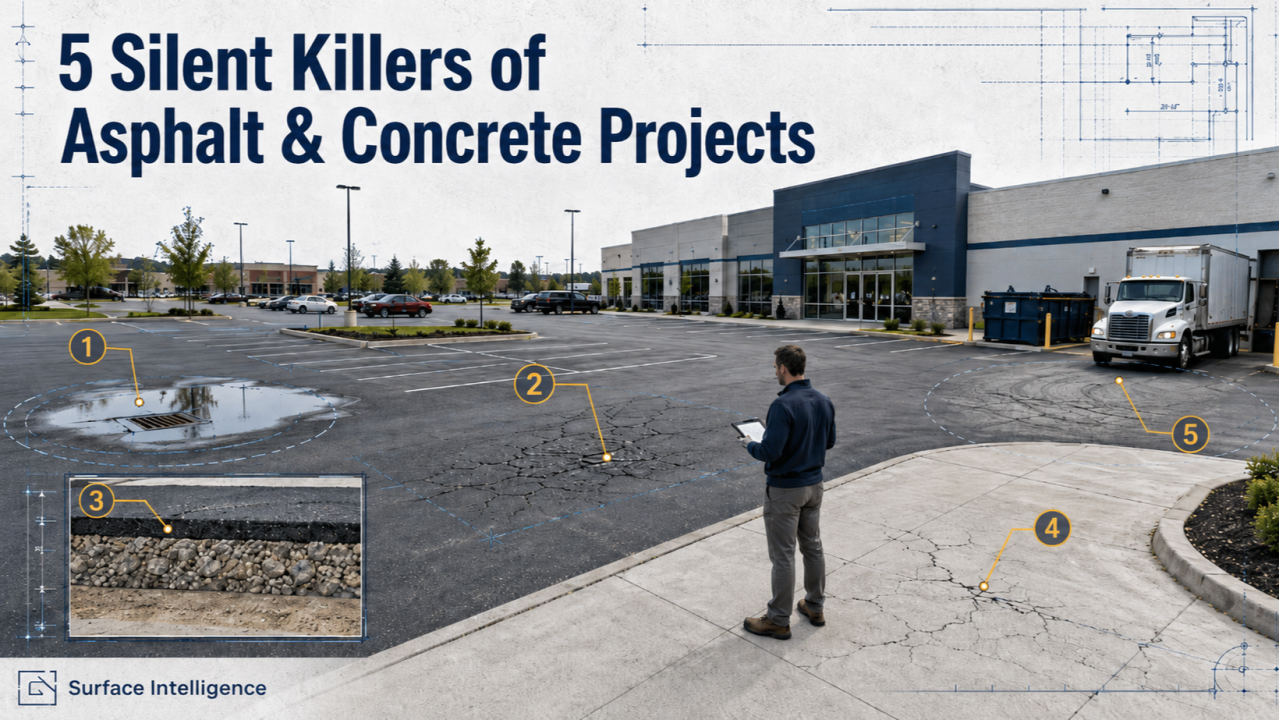
The lot looked finished. It wasn't built.
Dana manages a mixed retail and office center. It consists of approximately 140 stalls, a couple of long-term tenants, and the usual rotation of board members who show up when something breaks.
Last spring she approved a $90,000 paving project. Mill and overlay across the entire front lot, full-depth replacement at the entrance, new concrete apron surrounding the trash enclosure.
It looked great. Fresh black asphalt, crisp striping, clean concrete. The board signed off. Tenants stopped complaining about the potholes. Everyone moved on.
Then the first heavy rain rolled through in November.
Water pooled at the entrance. A birdbath formed right where the garbage truck swings into the enclosure. By spring that corner was cracking in a tight, scaly pattern. By the following winter it was coming apart, and the board wanted to know how a lot they "just paved" was already failing.
Here's the part that stung.
The asphalt wasn't bad. The crew wasn't lazy. The failure was baked in before the paver ever showed up. There was a soft spot under the entrance nobody checked, and a low corner grade the overlay quietly preserved instead of fixing.
The quote to fix the fix came in at nearly three times what the original base repair would have cost. That's the math nobody wants on the agenda.
These are the five places it goes wrong. Most of them are invisible by the time you would think to look.
1. Drainage that looked "close enough" on a dry day
Water and slope are the easiest pavement problems to ignore, because on a dry afternoon there is nothing to see. The lot looks clean and smooth and professional. Then it rains, and you find out whether the water actually moves or just sits there waiting to do damage.
Water kills pavement from underneath
It does not rot the surface first. It gets into the base and subgrade, and under traffic that saturated material starts to move. The Federal Highway Administration has said for decades that trapped water in the base and subgrade is one of the leading causes of pavement failure.
On the lot, drainage problems usually show up in ways you can physically point to: cracking that clusters around low areas, loose aggregate around standing water, and that rough gray surface where water repeatedly sits. In the trade, that surface breakdown is called raveling.
You may also notice soft or springy pavement near catch basins, or asphalt edges starting to crumble where water runs along the pavement instead of draining away from it.
And if you ever see dark stains weeping up out of a crack after a dry spell, that is water and fines pumping up from below under load. The base is already failing. The crack is just the messenger.
A paving scope is not a drainage scope
This is where managers get caught. They assume drainage is handled because a paving contractor is doing the work. It is not, unless someone put it in writing.
A good crew can lay a flawless mat of asphalt over a bad drainage condition. It will look perfect at closeout and pass your walk-through on a sunny day. But if the water still runs toward the building, or still pools in the same corner it always has, you did not solve anything. You spent real money to repaint the problem.
The overlay trap
Here is the one almost nobody catches. An overlay follows the grade that is already there. If the lot has a birdbath and you mill and pave without correcting the slope, you do not remove the low spot, you relaminate it. The new asphalt sits exactly where the old water sat, and now you have locked the problem in for another ten years and paid for the privilege.
So stop asking whether the new pavement looks good. Ask where the water goes after the work is done.
Before you approve anything, make the contractor walk the lot and call out the low areas, the flow lines, the catch basins, the building thresholds, and every spot that has ever held water. Even better is ask them to shoot elevations. Get it on a marked-up plan.
Then go back after it rains. Not the bid walk. Not a dry Tuesday. After rain, with your phone out.
Dry pavement shows you what the contractor wants you to see. Standing water shows you the truth.
2. A base nobody bothered to verify
Asphalt and concrete are only as good as what is under them. Everybody nods at that line, then approves a scope that takes the base completely on faith.
The base disappears, and so does your leverage
Once the asphalt is down or the concrete is poured, the base is gone. You will never again see whether it was soft, wet, thin, full of clay, or never corrected from the last failure. You are trusting it, forever, sight unseen.
Pavement is not structural on its own. It is a wearing surface that distributes traffic loads down into the base and subgrade. If that foundation cannot support the traffic, the surface eventually tells on it.
Asphalt starts cracking in that interconnected, scaly pattern known as fatigue cracking, commonly called alligator cracking. Concrete panels begin to rock. The low spot you thought was repaired starts to settle again.
Then the failure gets blamed on "bad asphalt."
Most of the time, it was never the asphalt.
Watch the language in the scope
Be careful with bids that rely on phrases like "compact existing base," "patch as needed," or "pave over prepared surface."
Those may be acceptable on a small repair. On a capital project, they can become an open door.
Prepared by whom? Acceptable by what standard? What happens when the crew digs in and finds a section of subgrade that is soft, wet, or unstable?
If there is no unit price for over-excavation, you will be negotiating it in the field after the crew is already mobilized and the clock is running. That is the worst possible time to talk price.
Get the answers before the project starts.
Will the base be proof-rolled or checked with a loaded truck to identify areas that flex before anything gets paved? Will compaction be tested and documented, or simply judged by the foreman? Is there a written unit price for removing unsuitable material and replacing it with clean rock?
Those details are what separate a real scope from a guess.
Why this is the section boards hate
Because it costs real money and shows nothing for it. Nobody can see good base. A board looks at a clean new surface and feels like they got their money's worth. They do not see the eight inches of properly compacted Class 2 aggregate base underneath, even though that is the part actually doing the work.
So there is pressure to skip it. To assume it is fine. To move the money to something visible.
I will say it plainly. Pretending the base is solid does not make it solid. It just moves the decision to the moment you can least afford it, after the lot is already failing, after the warranty has started arguing with you, and after the board has stopped trusting your numbers.
3. Thickness and compaction shortcuts
The cheapest bid is rarely lying. It is just quiet about what it left out.
The shortcuts you can see
Some are obvious once you know to look. A thinner asphalt section than the next bid. No allowance for base repair. No tack coat called out between the old surface and the new lift, or at the cold joints, so the layers never really bond. No reinforcement in concrete that is going to take truck loads. Each of those is a line item somebody dropped to win the job.
The shortcuts you can't
These are the issues that get you.
The bid calls for four inches of asphalt, and technically, four inches is what you receive. But the mix arrives cooler than it should. The crew is short a roller. The lift is placed too thin to compact properly. The joints are rolled cold and weak.
On paper, you bought the right pavement section.
In the ground, it never reached the density it needed to last.
Density is the whole game with asphalt. The Asphalt Institute generally targets air voids in the 3% to 7% range. Once air voids get too high, those spaces begin connecting into channels, allowing air and water to move through the pavement instead of being locked out.
In plain terms, under-compacted asphalt ages early.
Water gets in. Oxygen gets in. The binder dries out and becomes brittle years ahead of schedule. The lot starts looking ten years old when it is only five.
And there is no simple patch for that.
That failure was decided when it was first laid.
Concrete is not "pour it and broom it"
The same trap shows up in flatwork, just quieter. A real concrete scope addresses thickness, subgrade prep, reinforcement or dowels where the loads demand them, joint layout and spacing, the curing plan, and how it ties into the surrounding grade. A sidewalk panel, an ADA ramp, a dumpster pad, and a loading apron are four different problems. A vague bid prices them like they are one.
Two bids, same words, different projects
Picture two contractors on the same concrete work. One spells out excavation, base prep, 4,000 PSI mix, thickened edges, joint spacing, and a curing plan. The other writes "remove and replace concrete" and comes in eight percent cheaper.
The board sees two numbers and picks the lower one. But those are not two prices for the same project. They are two different projects that happen to share a sentence.
When you compare bids, read for the things that decide whether it lasts: compacted asphalt thickness, mix type, tack coat, base rock depth and compaction, concrete thickness and PSI, reinforcement, joint spacing, curing, and when traffic comes back. If a bid is silent on those, future issues are more than likely.
Do not buy "new asphalt." Buy a defined section, a defined process, and a scope you could actually inspect if you wanted to.
4. Weather decisions made to protect the schedule
Weather does not care about your board meeting, your fiscal year, or the email you sent tenants promising the lot would be open by Friday. It does what it does, and the material responds to the conditions, not the calendar.
Asphalt runs on a clock you can't see
The moment hot mix is batched into the haul truck, it starts cooling. By the time it reaches the ground, it has already lost a considerable amount of heat, and compaction has to be completed before the mix drops below the temperature where it can still move properly under a roller.
Cold ground, cold air, wind, and a long haul from the plant all shorten that window.
NAPA's position is reasonable. Cold-weather paving can be done, but it only works when the base, lift thickness, haul time, roller pattern, and joints are all planned around the conditions.
A thin lift placed late in the day on a cold, shaded surface is not the same product as that same mix placed at ten in the morning with enough time and temperature to compact it properly.
This is a Bay Area problem too
We do not get Minnesota winters, so people assume weather is not a factor here. It is. We get cold foggy mornings, shade that never burns off on the north side of a building, winter rain that saturates the base, and short daylight windows in December and January. The risk here is not a blizzard. It is a damp morning and an over optimistic schedule.
Concrete has its own rules
Cold-weather concrete is fine when it is mixed, placed, cured, and protected for the temperature. The ACI guidance is specific about that.
Hot, dry, windy days create the opposite problem. The surface loses moisture too quickly, which can lead to shrinkage, finishing issues, and early cracking.
That is how a slab can look perfect on Tuesday and show map cracking the following week.
The real tell is how they answer the questions
The silent killer is not bad weather. It is a crew that treats weather like it is irrelevant. So ask, before they mobilize: What is the lowest surface temperature you will place on? What is the call if rain shows up in the forecast? How wet is too wet for the base? How long until traffic comes back? And who actually makes the decision to postpone?
A contractor who knows what they are doing has those answers ready and probably respects that you asked. A weak one acts like the questions are an insult. That reaction is free information. Take it.
Nobody is telling you to cancel every job because the forecast is not perfect. That is not how work gets done. The point is to stop letting the calendar overrule the material, because the calendar is not the thing that has to last fifteen years.
5. The lot was built as if every foot of it does the same job
It does not. A parking lot is not one surface. It is a collection of zones that get used in completely different ways, and they fail accordingly.
Same asphalt, very different loads
A passenger-car drive aisle is not a fire lane. A visitor stall is not the approach to a trash enclosure. An HOA's private street is not a loading dock apron. They can be paved with the exact same section and look identical on day one, but a sedan rolling through and a loaded garbage truck pivoting on the same square of asphalt are not the same event.
Pavement fails where the loads are heavy, slow, and turning. That is the short list. Trash trucks, delivery trucks, fire apparatus, moving vans. The enclosure approach, the entrance throat, the tight turn everybody clips. Those spots come apart first while the open parking field, which barely sees a turning load, holds up fine.
That is why so many lots look acceptable overall and still have one wrecked corner. Go back and look. It is almost always the trash approach or the entrance. Dana's was both.
The averaging mistake
Here is how it happens. The manager asks for one number to "do the lot." The contractor bids one section across the whole thing. The board sees one price and makes one decision. But the lot does not wear as one uniform surface. It wears by use, and a single average section either overbuilds the easy areas or underbuilds the hard ones. Usually both.
A smarter scope breaks the property into zones and matches the construction to what each zone actually does: standard stalls, main drive aisles, heavy turning areas, the trash approach, loading zones, the ADA route, the low spots that hold water, the concrete flatwork. Each one gets evaluated for what it carries, not just its square footage.
And to be clear, zoning a lot does not mean spending more everywhere. It usually means spending more in one small brutal area and less everywhere else. That is the whole point. It is how you protect the budget instead of spreading it thin and watching the hardest-working ten percent of the lot fail on schedule.
The ADA zone is its own animal
One zone deserves singling out, because it is the one that turns a pavement problem into a legal one.
Accessible parking and the access aisle beside it have to stay nearly flat. The slope cannot exceed roughly two percent in any direction. That is a tight tolerance, and it is easy to blow during an overlay or a regrade. Drop an inch and a half of asphalt across an accessible stall without thinking about it and you can tip it out of compliance without anyone on the crew noticing.
Now connect that to drainage. If the accessible stall is also where water collects, you have stacked a slip hazard and an ADA violation in the exact spot where the law and the plaintiff's attorney are paying the closest attention, especially in California. Read The ADA Lawsuit Machine Is Real before you treat that as a striping-only issue.
And restriping does not save you. Paint follows grade. Fresh blue striping on a non-compliant slope just documents, in bright color, that the stall is out of tolerance. If you are touching pavement anywhere near accessible parking, the slope gets shot and recorded before and after. That is not optional. It is the cheapest insurance on the whole project.
Documentation isn't paperwork. It's the only thing that protects you later.
Documentation does not add a single day of life to the pavement. What it does is protect the person who approved the project when that project gets questioned. And it will get questioned. Read The Paper Trail That Saves You When the Lawsuit Arrives if you need the longer version.
When something fails, the questions come fast and they all point at the manager. Why did that area go? Was it the contractor's workmanship or a maintenance issue? Was it drainage? Was the board warned this might happen? Was that section in the scope or excluded? Is the warranty still alive, and does this even fall under it?
Without a file, every one of those is a guess, and guesses do not hold up in front of a board or an attorney. With a file, most of them answer themselves.
A real project file holds the before photos, the signed scope, a marked-up site map, the drainage notes, the written exclusions, the material specs, any compaction or testing reports, the concrete batch tickets, every change order, the weather log, progress and final photos, the warranty terms, and a calendar reminder for the six- and twelve-month checks.
For help creating documentation on ADA risk, use the ADA Issue Documentation Log.
That list reads like overkill right up until the morning a board member asks why a lot they paid $90,000 for is failing after one winter. On that morning the file is the most valuable thing you own, and the photos you did not take are the ones you will wish you had.
The bid-review checklist
Before you sign anything, make the bid answer these. If it cannot, it is not finished.
- Where does the water go after the work is done?
- Are the low areas, catch basins, and flow lines called out in the scope, or just assumed?
- What happens if soft base turns up, and is there a unit price for it, in writing, today?
- What compacted asphalt thickness and mix type are included, and is tack coat in there?
- For concrete: what thickness, PSI, reinforcement, and joint spacing?
- Are the high-load zones built differently than the open parking, or is it one section for everything?
- What are the temperature and weather limits for placement, and when does traffic return?
- Is the ADA parking slope getting verified before and after?
- What documentation comes at closeout, and who owns the six- and twelve-month follow-up?
A bid that goes quiet on those is not necessarily a bad bid, and it is not necessarily a bad contractor. But it is not complete enough for you to put your name on. And your name is the one that is on it.
For a deeper scope review, read How to Read a Pavement Bid Without Getting Played.
What to actually do this quarter
You do not need a capital project on the calendar to start protecting yourself. You need one rainy afternoon and a phone.
Walk a property right after the next storm. Photograph everything holding water. Mark the trash approaches, the loading zones, the heavy turns, and the ADA routes. You will learn more about that lot in twenty wet minutes than in a year of dry inspections.
Then pull the file from your last paving job and see what is actually in it. Is the warranty there? The material specs? The closeout photos? Anything at all showing what happened below the surface? If the file is thin, that is not a crisis. It is a free lesson, as long as you take it before the next project instead of during the next failure.
Because the expensive failures almost never start with a dramatic mistake. They start quiet. A vague scope. A low corner an overlay preserved instead of fixing. A soft spot nobody proof-rolled. A thin lift placed on a cold morning because the schedule was tight and somebody decided the weather did not matter that day.
That is the line between maintenance planning and crisis spending, and it gets drawn before the first truck arrives, not after the first failure.
Dana knows that now. The reserve took the hit, the board remembers, and the file from her next project is going to be a lot thicker.
If you manage asphalt, concrete, ADA access, or common-area pavement, this is the stuff that belongs in your property file long before it becomes a board emergency.
Get help before the scope gets approved.
Send Ryan the property location, photos, bid language, and the areas that hold water or carry heavy traffic. He can help you see whether the scope is solving the real problem or just making the surface look finished.
Sources
- Federal Highway Administration, Geotechnical Aspects of Pavements, Chapter 7.
- Asphalt Institute, Engineering FAQs: recommended compacted air void content.
- National Asphalt Pavement Association, Cold Weather Compaction.
- American Concrete Institute, ACI 306R-16: Guide to Cold Weather Concreting preview.