
A routine resurfacing isn't routine anymore
Here is a project that used to be simple. The parking lot is cracked and tired, so you pull out the old asphalt, put down new asphalt, restripe, and move on. Maintenance. A few weeks, a known number, no drama.
In much of the Bay Area, that same project now can require a stormwater permit, a civil engineer, facility drawings, treatment infrastructure, and a maintenance agreement recorded against the property that runs with it forever. Property managers and contractors are finding this out the hard way, mid-permit, as jurisdictions enforce a rule that has been on the books since 2023 but is only now being applied with teeth.
The trigger is smaller than most people expect, and the trap is a single phrase in the definition. Here is what is actually happening and how to stay on the right side of it.
Where the rule comes from
The requirement lives in Provision C.3 of the Municipal Regional Stormwater Permit (MRP), issued by the San Francisco Bay Regional Water Quality Control Board under the Clean Water Act's National Pollutant Discharge Elimination System program. The current version, MRP 3.0, was last amended in October 2023 and covers municipalities across Alameda, Contra Costa, San Mateo, and Santa Clara counties, plus Fairfield, Suisun City, and Vallejo in Solano County.
The number that changed the game took effect July 1, 2023. The threshold for triggering stormwater treatment requirements dropped from 10,000 square feet of impervious surface to 5,000 square feet. In parking terms, that is roughly 15 to 18 stalls once you include the drive aisles. A lot of "mid-size" lots that used to sail under the line now sit right on top of it.
What actually triggers the requirements
It comes down to how much impervious surface you create or replace.
Regulated Projects — 5,000 sq ft and up
Create or replace 5,000+ square feet of impervious surface and you have to install stormwater treatment measures, sized per the C.3 Guidebook criteria. Mid-size retail lots and moderate HOA parking areas routinely cross this line. Projects over one acre (43,560 sq ft) have to provide both treatment and flow control.
Small Projects — 2,500 to just under 5,000 sq ft
These require at least one basic site-design measure — directing runoff onto a vegetated area, using a permeable material, that kind of thing. Lighter than a full Regulated Project, but not nothing.
Single-family homes
These face a higher 10,000 sq ft threshold before treatment requirements apply. Commercial and multifamily do not get that cushion.
The "remove and replace" trap
This is the phrase that catches people. The regulation specifically targets projects that involve removal of the existing surface and exposure of the base layer. Standard asphalt replacement — milling or excavating down to the base rock — is classified as redevelopment from a stormwater standpoint, even though you see it as routine maintenance.
In other words, the thing that determines whether you triggered a Regulated Project is not "did I make the lot bigger." It is "did I dig down to base." Full-depth remove-and-replace exposes the base and counts. That is the distinction the whole rule turns on.
What stays exempt
The good news: a large category of work is explicitly treated as maintenance and stays exempt, as long as you don't expand the paved footprint. That includes:
- Overlaying existing asphalt or concrete with new asphalt or concrete, without expanding the paved area
- Wedge grinding during an overlay upgrade, without expanding coverage
- Upgrading a chip-seal surface with an asphalt or concrete overlay
- Applying a new bituminous surface treatment without expanding coverage
- Top-layer grinding and repaving within the existing footprint
The key distinction is simple to say and expensive to miss: mill-and-overlay stays maintenance; full removal that exposes the base becomes a Regulated Project.
What treatment actually looks like
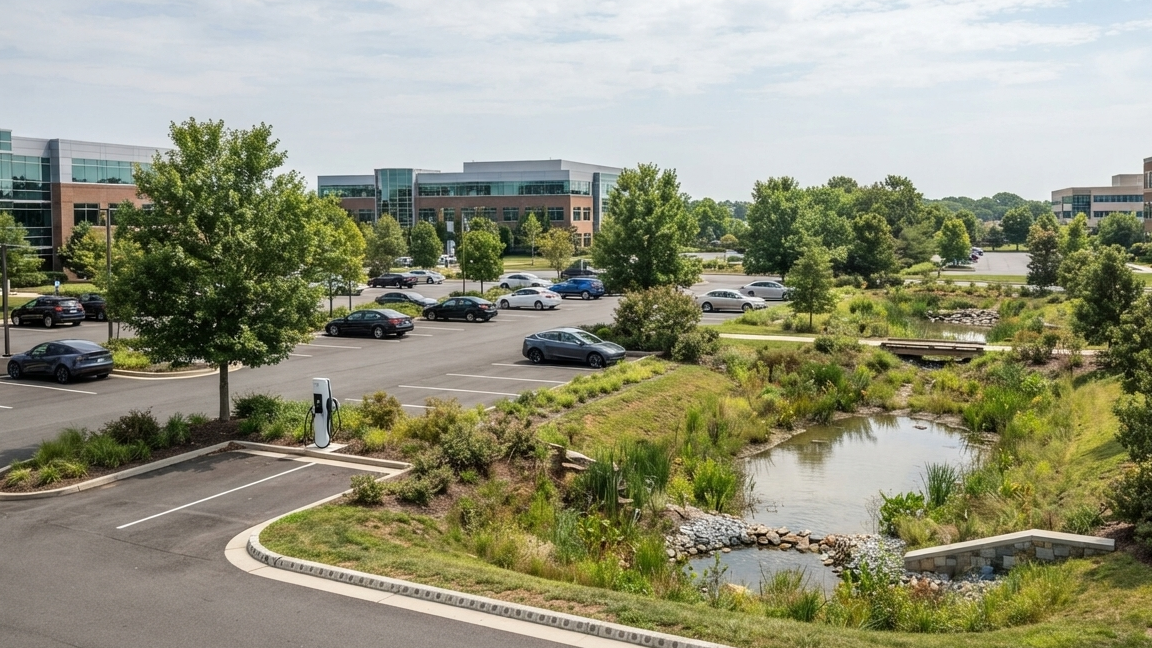
If you do trigger a Regulated Project, "treatment" means real infrastructure sized to hydraulic criteria, not a line item. The common options for parking lots:
- Bioretention (rain gardens): shallow landscaped depressions with engineered soil and gravel that collect, filter, and infiltrate runoff. The most common choice for lots.
- Permeable pavement: permeable interlocking pavers, pervious concrete, or porous asphalt over a stone base that lets water pass through and infiltrate.
- Media filters and tree-well filters: engineered filtration units, sometimes below grade or in planter boxes.
- Self-retaining areas: runoff routed directly onto adjacent landscaping sized to absorb it.
- Retention and detention: retention infiltrates or evaporates over time; detention holds water during a storm and releases it at a controlled rate.
All of it has to be sized per the C.3 Guidebook, which means civil engineering and a formal Stormwater Control Plan.
The obligation doesn't end at construction
This is the part that surprises boards most. A Regulated Project has to execute a long-term Operations and Maintenance Agreement, recorded against the property, that runs with it regardless of who owns it next. The regulation requires the treatment measures be maintained in perpetuity. Municipalities inspect on a recurring cycle — often every five years — and some jurisdictions now publish formal fee and fine schedules for non-compliance. You are not buying a one-time upgrade; you are taking on a permanent maintenance duty attached to the deed.
What it does to the budget and the timeline
Before a single truck of asphalt shows up, a Regulated Project adds:
- Civil engineering and a Stormwater Control Plan
- A separate plan-review cycle at the permit office
- Construction of the treatment measures, on top of the paving scope
- A recorded O&M agreement
- Ongoing inspection and maintenance costs, indefinitely
The dollar impact varies with soil conditions, drainage design, site constraints, and which jurisdiction is reviewing. But the bigger shock is usually the calendar: a project you thought was a two-week repave can turn into a multi-month permitting exercise.
How to avoid or minimize the trigger
- Measure precisely before you bid. What matters is the square footage of surface you remove, not the total lot size. A 40,000 sq ft lot that only needs 4,800 sq ft of removal stays under the threshold — if you scope it that way on purpose.
- Default to mill-and-overlay when it's structurally feasible. Overlaying within the existing footprint avoids C.3 review entirely and can take a four-month process down to two weeks.
- Use permeable pavement as the treatment. Installed correctly, it can satisfy the treatment requirement without a separate facility — useful on tight urban sites with no room for a rain garden.
- Phase deliberately, with legal and engineering guidance. Jurisdictions aggregate phased work on the same parcel within a defined window, so you can't dodge the threshold by slicing one job into pieces. Confirm the phasing rules in writing first.
- Request a pre-application meeting. Most MRP jurisdictions offer C.3 checklists and staff review. An hour up front can save weeks versus discovering a reclassification mid-permit.
- Bring in an experienced civil engineer early. Sizing calculations, drainage-area mapping, and Stormwater Control Plans reward prior C.3 experience. Inexperienced contractors underbid this and make it up in change orders.
Who gets caught the most
Commercial property managers with 15 to 18+ stalls, HOA boards planning a full resurfacing instead of a maintenance overlay, and facility managers over industrial or retail sites are most likely to cross the line without meaning to. Restaurants, gas stations, and auto-service sites can hit Regulated Project status at 5,000 square feet even when the overall parcel is small.
The bottom line
This rule is not new — it has been in force since 2023. What is new is enforcement catching up across every MRP-covered county. The managers and contractors who measure removal precisely, default to overlay where the structure allows it, and get engineering involved before design decisions are locked will spend less and finish faster. The ones who find out after a permit rejection will pay for the education. Before you compare bids on a resurfacing, it is worth reading How to Read a Pavement Bid Without Getting Played so the stormwater scope doesn't hide inside a single lump-sum number.
Not sure if your resurfacing trips the 5,000 sq ft line?
Send Ryan the property location and the area you're planning to remove and replace. He can tell you whether the scope stays maintenance-class overlay or crosses into a Regulated Project — before you're standing in a permit office finding out.
Sources
- San Francisco Bay Regional Water Quality Control Board, Municipal Regional Stormwater Permit (MRP).
- Contra Costa Clean Water Program, C.3 Stormwater Development Guidance and Guidebook.
- U.S. Environmental Protection Agency, National Pollutant Discharge Elimination System (NPDES).