
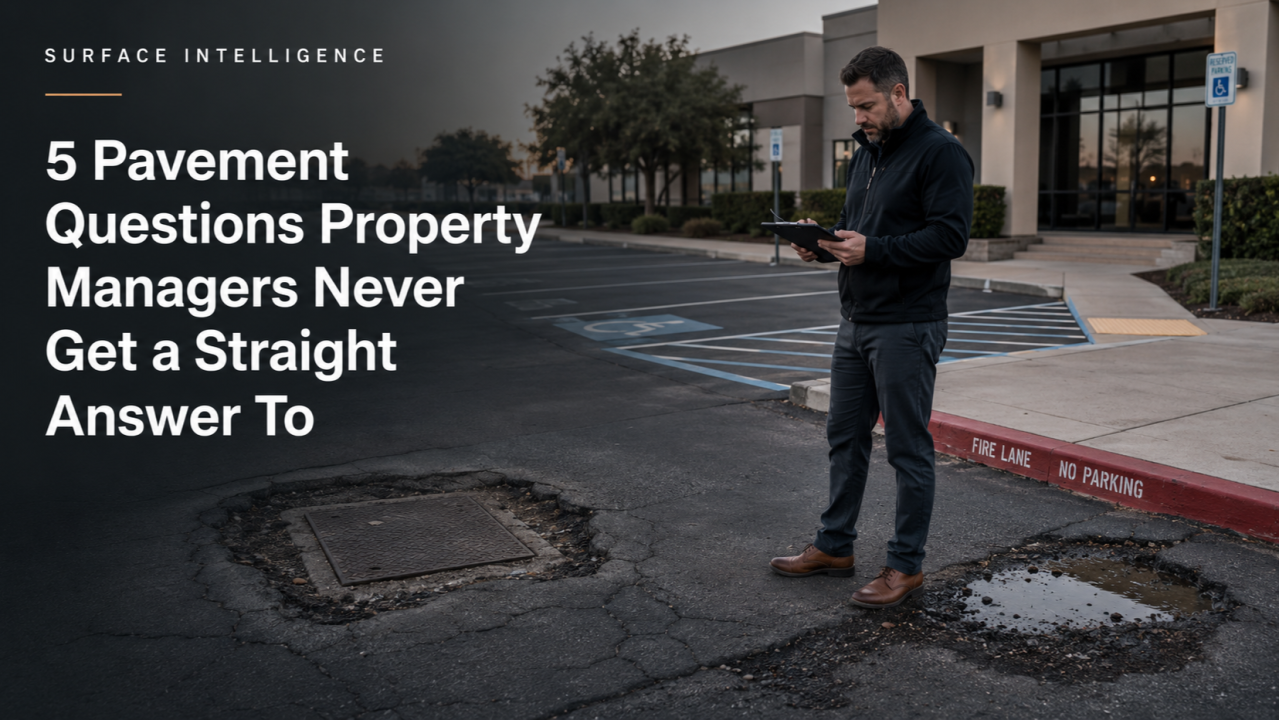
The questions nobody gives you a straight answer to
Most pavement problems have an obvious owner. A pothole gets patched. A faded stall gets restriped. A cracked panel gets replaced. Somebody knows who to call and roughly what it costs.
The expensive problems live somewhere else. They live in the gray zone, where it is not clear whose job it is, whose budget it comes from, or whether it is even a problem yet. Those are the questions property managers actually lie awake on, and they are the ones every contractor seems to answer with a shrug.
Here are five of them, with the straight answer attached.
1. Who is actually on the hook when a utility patch fails?
A utility crew cuts a trench across your lot to reach a line, drops the pipe, backfills, and throws a patch of asphalt on top. Six months later that patch has sunk, cracked, and started letting water into the base around it. Now it is your lot, your tenant complaints, and your repair.
Why the patch fails
Almost every time, it is compaction. A trench has to be backfilled and compacted in shallow lifts, not dumped full and tamped once on top. When it is not, the loose fill keeps settling under traffic, the patch drops with it, and the seam around it opens up. Water gets in, and the failure spreads past the original cut.
The straight answer
You get leverage before the backfill, not after. Photograph every utility cut on your property the day it happens. Get the restoration standard and the timeline in writing — real compaction in lifts, not "we'll patch it." Then put a reminder on the calendar to reinspect that patch at six and twelve months, while the responsible party is still reachable and still cares. Documentation is the entire game here; without it, "the utility did it" is just your word.
2. Is red paint the same thing as a compliant fire lane?
No, and this one catches people. Red curb and a "FIRE LANE — NO PARKING" stencil is the visible five percent. It is not what makes the lane legal.
What a fire lane actually has to do
A fire apparatus access lane has to satisfy the local Authority Having Jurisdiction, and those requirements are structural, not cosmetic. Typically that means an unobstructed width in the range of 20 to 26 feet, vertical clearance around 13 feet 6 inches, a maximum grade near the low teens (commonly about 14 percent), and — the one everyone forgets — enough load capacity to carry a loaded truck, often 75,000 pounds or more. Paint does nothing for any of that.
The straight answer
Confirm width, clearance, signage, and load rating with your local fire authority, in writing, and verify the pavement section under that lane can actually carry apparatus weight. A lane that looks compliant and flexes under a fire truck is a lane that will fail exactly where you cannot afford it to.
3. When does a lip in the pavement become a real trip hazard?
This is the question behind most slip-and-fall nerves, and there is an actual threshold, not a vibe.
The danger zone
Vertical displacement between about a quarter inch and a half inch is where a defect stops being trivial and becomes actionable. Under the ADA standards for changes in level, up to a quarter inch is allowed as-is, a quarter to a half inch has to be beveled, and anything over a half inch has to be ramped. That quarter-inch line is where your risk starts, not where it ends.
The straight answer
Treat a quarter-inch lip as your action threshold on any pedestrian route. Measure it, photograph it, and fix it — grind, bevel, ramp, or replace — before it becomes a claim instead of a work order. A five-minute grind today is cheaper than a deposition later. Log it with the ADA Issue Documentation Log so the fix is on the record.
4. If my ADA stalls are compliant, am I covered?
Compliant stalls and access aisles are necessary and nowhere near sufficient. The stall is the part everyone checks. The route is the part that gets sued.
The route is the real test
An accessible route has to run continuous and unobstructed from the accessible stall all the way to the building entrance, with running slope no steeper than about 5 percent, cross slope under roughly 2 percent, no abrupt level changes, adequate width, and nothing blocking the path — not a curb, not a planter, not a car overhang. A perfect stall that dumps a wheelchair user onto a 6 percent slope or a lip at the curb is not compliant, and a stall-only inspection will never catch it.
The straight answer
Walk the actual path from your accessible stalls to every entrance and shoot the slopes along the way. Full-route inspections find the gaps that stall reviews miss. In California, where the Unruh Act stacks statutory damages on top of federal ADA exposure, that walk is the cheapest insurance you own — see The ADA Lawsuit Machine Is Real and pressure-test the property with the ADA Risk Scorecard.
5. What is my pavement warranty actually going to cover?
Less than you think, and specifically not the part most likely to fail.
Read the exclusions, not the headline
A standard pavement warranty splits coverage between workmanship and materials, and then excludes most base and subgrade failures — which is the layer that fails most often. Reflective cracking, standing-water damage, and heavy-load distress usually fall outside coverage too. So the warranty protects the pavement against everything except the reasons pavement usually comes apart.
The straight answer
Read the exclusions before you sign, not after the failure. Know the difference between a workmanship claim and a base-failure claim, and understand that if your subgrade is questionable, the warranty is not going to save you. That is a scope conversation to have up front. If you are comparing bids, How to Read a Pavement Bid Without Getting Played walks through where coverage quietly disappears.
Why these five are the ones that get you
Notice the pattern. None of these have an obvious contractor, an obvious budget line, or an obvious moment where someone hands you the answer. That ambiguity is exactly why they escalate. The utility patch, the fire lane, the quarter-inch lip, the ADA route, the warranty exclusion — each one sits quietly until it becomes somebody's expensive problem, and that somebody is usually the manager who never got a straight answer.
Catch them early, document them, and they stay small. Ignore them because nobody told you they were yours, and they compound.
Not sure which of these you're exposed on?
Send Ryan the property location, photos of the patch, the lane, the lip, or the ADA route, and any warranty language you're unsure about. He'll tell you straight which ones are real risk and which ones can wait.
Sources
- U.S. Department of Justice, 2010 ADA Standards for Accessible Design (accessible routes, slopes, and parking).
- U.S. Access Board, Guide to the ADA Standards: Changes in Level.
- International Code Council, International Fire Code, Chapter 5: Fire Apparatus Access Roads.
- Federal Highway Administration, Geotechnical Aspects of Pavements (trench backfill and base performance).